⚡ Atomix
One-Click Enterprise Data Platform Framework
Executive Summary
Atomix transformed enterprise data platform delivery from a 12-24 month, multi-million-dollar engineering effort into a days-long deployment. Built with a self-service data marketplace at its core, it enabled producers to publish data assets and consumers to discover and access data without IT bottlenecks, fundamentally changing how organizations leverage data for competitive advantage.
Situation
Enterprise data platform development had become a systemic bottleneck. Delivering a production-ready platform required 12-24 months of custom engineering, deep expertise across 30+ AWS services, and millions of dollars in investment. Business teams waited weeks or months to access data, with no self-service way to discover what data existed or request access.
Task
Transform data platform delivery from a multi-year engineering project into a repeatable, configuration-driven process with a self-service marketplace at its core. The challenge wasn't building a data lake - it was solving an organizational platform delivery problem requiring:
- One-Click Deployment: Transform 12-24 months of custom development into days-long deployment
- Self-Service Marketplace: Enable producers to publish data assets and consumers to discover, request, and access data without IT bottlenecks
- Automated Workflows: Replace manual email chains with streamlined approval processes
- Multi-Account Architecture: Support single, two, and three-account deployment models with proper isolation
- Data Mesh at Scale: Enable multiple producers to share data with multiple consumers through marketplace
- Universal Ingestion: Support batch, micro-batch, near real-time, and CDC through configuration, not code
- Automated Pipeline: Build end-to-end pipelines from landing to curated zones with orchestration
- PII Detection: Automatically identify and handle sensitive data with centralized governance
- Zero-Code Configuration: Enable data engineers to configure ingestion through UI
- Multi-Tenant Support: Isolate and manage multiple business units with proper security boundaries
Action
Built Atomix as a comprehensive, configuration-driven framework with a self-service data marketplace transforming data platform delivery from custom engineering to repeatable deployment.
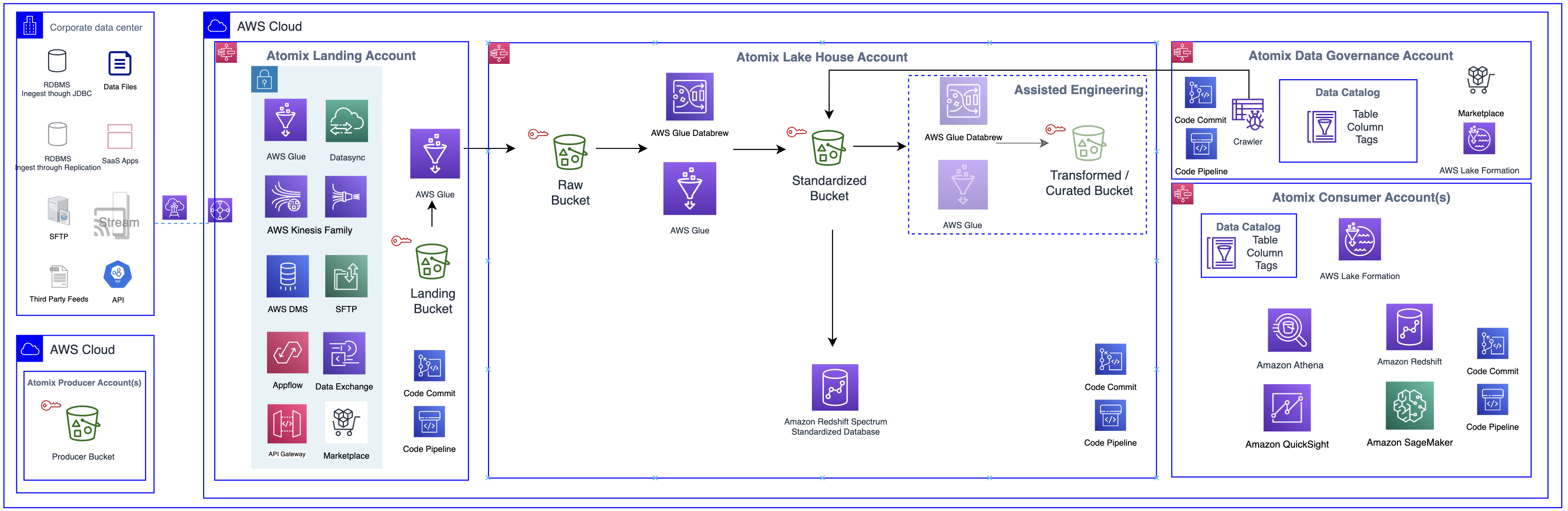
Architecture Highlights
- Multi-Account Flexibility: Single, two, and three-account deployment models for different security requirements
- Self-Service Marketplace: Producers publish data assets, consumers discover and request access without IT intervention
- Lake House Architecture: Four data zones (Raw, Standardized, Transformed, Curated) supporting lake and warehouse patterns
- Governance Account: Centralized metadata catalog, policy management, and cross-account sharing
- Automated Pipeline: End-to-end orchestration from landing through curation with PII detection
Data Marketplace: Transforming Data Access
For Producers
- Browse and select data sources through intuitive catalog
- Configure ingestion strategy (Full Load, Incremental, CDC) without code
- Define schedules, data quality rules, business descriptions, and access policies
- Submit for approval, then Atomix automatically creates complete pipeline and monitoring
For Consumers
- Browse marketplace catalog with rich metadata, business descriptions, and data quality metrics
- Search and filter by business domain, data type, update frequency, or keywords
- Preview schemas, sample records, and data lineage before requesting access
- Request access with one click, specifying use case and business justification
- Once approved, immediately access data from own AWS account without replication
Golden Copy Advantage
- Centralized Storage: All data remains in central Lake House as single golden copy
- Cross-Account Access: Consumers access directly using Lake Formation and Resource Access Manager
- Real-Time Updates: Consumers always see latest data without replication
- Cost Optimization: Eliminates duplicate storage across accounts and business units
- Governance Maintained: Data owners retain full control over access policies
Technology Stack
Ingestion:
Processing & Governance:
Storage & Analytics:
Orchestration & Events:
Platform & UX:
Infrastructure:
Key Architectural Decisions
Configuration-Driven Framework over Custom Code
Decision: Configuration-driven approach enabled data engineers without deep coding expertise to deploy pipelines in hours instead of weeks. Targeted 80% of use cases through configuration while maintaining flexibility for complex transformations.
Tradeoff: Limited customization for edge cases, mitigated by allowing custom Glue jobs for remaining 20%.
Multi-Account Architecture over Single Account
Decision: Enterprise security and compliance demanded account-level isolation between landing, processing, and governance layers. Supporting multiple deployment models enabled customers to choose based on risk tolerance.
Tradeoff: Increased architectural complexity and cross-account IAM management, but essential for enterprise adoption.
Parquet Standardization over Format Flexibility
Decision: Standardizing on Parquet provided 10x query performance improvement and 70% storage cost reduction through columnar compression.
Tradeoff: Conversion overhead during ingestion (5-10% processing time increase), but massive gains in query performance and storage costs justified investment.
Lake Formation for Access Control over IAM-Only
Decision: Lake Formation's fine-grained access control (column and row level) was essential for true data mesh, enabling secure cross-account sharing. IAM alone couldn't provide required granularity.
Tradeoff: Added complexity in permission management, but enabled data democratization while maintaining security.
Result
Business Impact
- Rapid Deployment: Customers deployed complete platforms in days instead of 12-24 months
- Zero-Code Configuration: Data engineers configured ingestion through UI. 80% reduction in engineering effort
- Marketplace-Driven Access: Self-service marketplace reduced data access time from 3-4 weeks to less than 24 hours
- Data Discovery Revolution: Business teams discovered and accessed data assets through marketplace in minutes instead of weeks
- Cost Optimization: Eliminated duplicate storage, reduced manual processing, optimized storage formats. 60% reduction in operational costs
- Automated Workflows: Marketplace approval processes that took weeks now completed in hours
- Enhanced Governance: Centralized PII handling and Lake Formation access control ensured compliance while maintaining agility
- Data Democratization: Self-service marketplace enabled broader data-driven decision making without IT bottlenecks
Recognized for innovative one-click data framework implementation at a large GFS enterprise customer, enabling fast data discovery, zero-code data availability, and near real-time secure data access.
Demo Video
Atomix Demo
See one-click deployment, configuration-driven ingestion, and seamless data sharing
▶️ Watch Demo on YouTubeKey Features
Marketplace Capabilities
- Self-Service Discovery: Intuitive catalog for browsing and discovering data assets across the organization
- Rich Metadata: Business descriptions, data quality metrics, update frequency, and sample data
- Flexible Ingestion: Configure full load, incremental, or CDC strategies without code
- Automated Workflows: Configurable approval processes for publishing and consumption
- Centralized Sharing: Access data from own accounts without replication. Golden copy remains centralized
- Real-Time Access: Immediately access latest data without replication or synchronization
- Usage Analytics: Track which data assets are most valuable and how they're being used
Platform Capabilities
- One-Click Deployment: Deploy complete data platform across single, two, or three-account architectures
- Automated Pipeline: End-to-end orchestration with PII detection, data lineage, and format standardization
- Universal Ingestion: Batch, micro-batch, near real-time, and streaming from databases, SaaS apps, files, and APIs
- Cross-Account Sharing: Share S3 and Redshift data with centralized governance and fine-grained access control
- Multi-Tenant Support: Isolate and manage multiple business units with proper security boundaries
Key Learnings
Marketplace & Self-Service
- Discovery Drives Adoption: The marketplace's ability to make data discoverable was more valuable than ingestion capabilities. Business teams couldn't use data they didn't know existed
- Self-Service Eliminates Bottlenecks: Marketplace enabling configuration without IT intervention reduced data access time by 95% and eliminated 200+ request backlog
- Workflows Balance Speed & Governance: Marketplace automated workflows maintained governance while accelerating access. Key was making approvals transparent and trackable
- Golden Copy Saves Millions: Marketplace centralized architecture eliminated 70% of duplicate storage costs while ensuring consistency
- Business Context Matters: Rich metadata and business descriptions in marketplace were essential. Technical schemas alone didn't help business users
- Usage Analytics Drive Value: Marketplace tracking of most-accessed data helped organizations prioritize quality improvements for high-impact datasets
Technical
- Configuration Over Code: Configuration-driven frameworks dramatically reduce development time but require careful abstraction design
- Multi-Account Complexity: Supporting multiple deployment models adds complexity but is essential for enterprise adoption with varying security requirements
- Parquet Standardization: Converting to Parquet with consistent partitioning provides 10x query performance improvements and significant cost savings
- Lake Formation for Data Mesh: Fine-grained access control is critical for true data mesh, enabling secure cross-account sharing
- PII Automation: Automated PII detection and standardization is non-negotiable for enterprise platforms to ensure compliance at scale
Product & UX
- Marketplace UX is Critical: The marketplace interface needed consumer e-commerce intuitiveness. Business users expected Amazon-like discovery and one-click access
- Progressive Configuration: Marketplace allowing producers to start with simple full-load ingestion, then adding incremental or CDC options reduced initial complexity and accelerated adoption
- Transparency Builds Trust: Marketplace showing approval status, data lineage, and access history built trust with data owners and consumers, reducing governance concerns
- Real-Time Feedback: Immediate marketplace confirmation when data assets were published or access granted improved user confidence and reduced support tickets
- Start Simple, Scale Complex: Begin with single-account deployment for quick wins, then migrate to multi-account as governance requirements grow